Pro League Soccer
- 3.8
- Rating
- 100.00M
- Installs
- Free
- Price

 Analysis by App-foxy
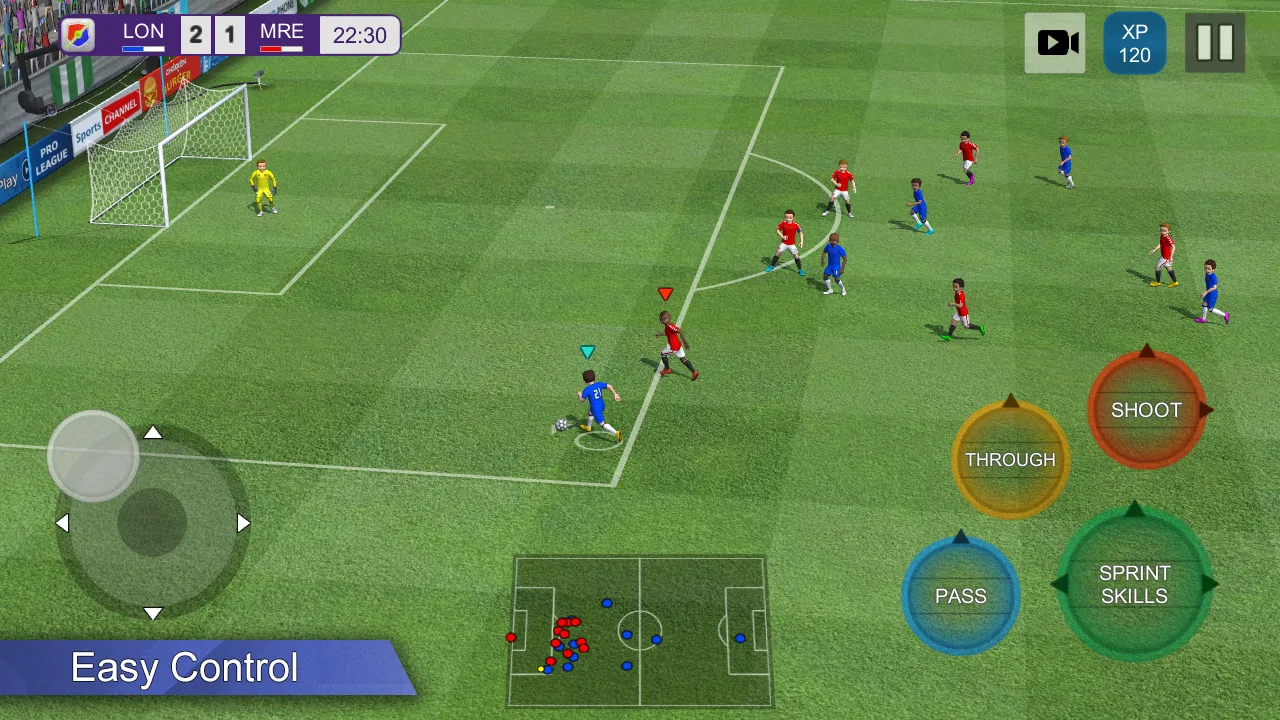
Pro League Soccer is the kind of mobile football game I open when I want a quick match without turning the whole evening into a serious gaming session. Developed by Rasu Games, it focuses on the basic appeal of football: move the ball, create space, defend carefully, and try to finish chances before the opponent settles into shape. That sounds simple, but the quality of a football game depends heavily on how much control it gives me during those small moments.
My main focus here is the game’s direct match control. Rather than treating football as a menu-heavy management exercise, it puts the important decisions in my hands while the match is happening. I decide when to pass, where to aim, how aggressively to attack, and whether to protect a narrow lead. That makes it easy to understand, but it also means mistakes feel personal: a rushed pass or poorly chosen shot is usually my responsibility.
As a free sports game for Everyone, it is approachable for a broad audience. The game has attracted over 100 million installs, which tells me it has reached far beyond a small group of dedicated football fans. Its average rating is 3.8 from around 447 thousand ratings, a useful sign that many players find the core experience worthwhile while also leaving room for individual preferences and frustrations.
You May Also Like

 AccuWeather: Weather Radar
AccuWeather Review: A Quick, Clear Forecast for Everyday Decisions
For everyday plans, the best forecast is the one you can understand quickly. AccuWeather makes rain timing, radar, and local conditions easy to act on, with a few trade-offs.

 Hill Climb Racing
Why Hill Climb Racing Still Turns Crashes Into One More Run
A tiny car, a bumpy hill and one more upgrade: Hill Climb Racing keeps resurfacing because its simple chaos makes every near-miss feel personal.

 AliExpress - Shopping App
AliExpress Makes Global Shopping Feel Personal, but Shoppers Bear the Risk
AliExpress turns a global marketplace into a pocket-sized discovery engine. Its reach is useful, its shopping loop compelling, and its trade-offs easy to miss.

 Lords Mobile: Kingdom Wars
Lords Mobile Is a Kingdom-Building Routine, Not a Quick Match
A case-by-case verdict on the building, battles, device demands, and social commitments that make Lords Mobile rewarding for some players and exhausting for others.

 PDF Scanner app - TapScanner
TapScanner Makes Paperwork Easier to Capture, Check, and Share
TapScanner makes scanning with a phone feel less like a rescue operation and more like a dependable step in getting work done. Its capture tools are useful, though not flawless.

 Block Blast!
 Shows How Much a Puzzle Game Can Leave Out
A quiet grid game shows why puzzle players increasingly value instant clarity, repeatable skill and low-pressure play—and where the genre still needs to catch up.
More From Our News Desk
View All News


Why direct control is the heart of the experience
The strongest reason to try Pro League Soccer is that it lets me participate in the match instead of merely watching numbers change. In a management-focused football title, I may choose a lineup or strategy and then wait for the result. Here, the interesting part happens during play. I have to read the movement around me and make a decision before the opportunity disappears.
That direct approach gives ordinary situations more weight. A pass near midfield is not just a routine action when an opponent is closing down. It becomes a choice between keeping possession safely, attempting a forward ball, or carrying the ball into space. Near the penalty area, the same principle applies to shooting. I cannot assume that every attack should end with an immediate attempt. Waiting for a clearer angle can be more useful than forcing a shot through a crowded area.
I also like how this design makes short sessions meaningful. I do not need a long preparation routine to enjoy a match. If I have a spare break, I can play a little, experiment with my approach, and stop when I am done. That makes it more convenient than larger football games that expect constant attention to squads, events, currencies, or lengthy progression systems.
At the same time, direct control is not automatically the same as perfect control. Touchscreen football always depends on how clearly the game interprets an input. A pass can feel obvious to me but still produce an outcome I did not expect if the angle, distance, or pressure around the player is wrong. I found that the game rewards calm decisions more than frantic tapping, but players who want a highly precise simulation may notice the limits of playing on a phone.
Reading the match instead of chasing the ball
The most useful adjustment I made was to stop treating possession as a race toward the opponent’s goal. When I tried to push forward every time I received the ball, I created predictable attacks and gave the other side easy chances to recover. A safer rhythm worked better: pass sideways or backward when the forward lane was blocked, then look for the next opening rather than forcing the first idea.
This is where the game becomes more interesting than its simple presentation might suggest. The controls may be easy to pick up, but the results improve when I pay attention to spacing. A player who receives the ball with no nearby support is a problem waiting to happen. A pass into a teammate’s path, rather than directly into a crowded position, gives the next action more possibilities.
Defending benefits from the same patience. Chasing the ball carrier immediately can pull a defender away from the area I actually need to protect. I had better results when I stayed between the attacker and the dangerous space, waited for a poor touch, and then challenged. This does not make every defensive situation easy, but it gives me a clearer plan than simply pressing whenever the opponent comes close.
The practical lesson is to use the controls to create time, not just movement. A short pass that keeps possession can be more valuable than a spectacular forward attempt. A controlled defensive position can prevent a chance before a tackle becomes necessary. These small choices are the real payoff of the game’s central capability.
What a normal short session feels like
A realistic use case is a ten-minute break when I want something more engaging than scrolling but do not want to commit to a complicated game. I can start a match, spend the opening moments understanding the opponent’s shape, and then decide whether to play cautiously or take more risks. If I score first, the match changes because protecting the advantage becomes a separate challenge from creating it.
In that situation, I usually avoid constant attacking. I keep the ball moving, make the opponent work to regain possession, and only accelerate when a teammate has room. If I concede, I try not to respond with desperate forward passes. The quickest way to lose control is to turn one setback into several rushed decisions.
This makes the game suitable for players who enjoy the feeling of football decisions but have limited time. It is less suitable for someone who wants a long, deeply detailed career experience in every session. The short-match appeal is a strength, but it also means the experience is built around repeated play rather than one huge narrative journey.
How it compares with other mobile football choices
Compared with football management games, Pro League Soccer gives me more responsibility during the match and less emphasis on planning from menus. That is better when I want to feel involved in each attack. A management title may be the stronger choice if my favorite part of football is building a squad, adjusting long-term tactics, or watching a season develop through decisions made away from the pitch.
Compared with highly elaborate football games, this one feels easier to approach. I do not need to spend a long time learning a large control system before I can enjoy a basic match. The trade-off is depth. Players who expect the presentation, licensed detail, and broad online ecosystem of the biggest football releases may find this experience more modest.
It also differs from very casual arcade football games. The direct match structure still leaves room for judgment, so I cannot rely entirely on fast reactions or repeated attacking patterns. If I want a football game that is immediately playful and almost frictionless, an arcade alternative may feel lighter. If I want my passing and defensive choices to matter, Pro League Soccer has the more appealing balance.
Small habits that improve the experience
My first tip is to learn the value of the safe pass. When the forward route is covered, keeping possession is not wasted time. It can draw defenders out and open a better lane on the next move. This is especially helpful for players who initially feel that every touch must move toward goal.
Second, I recommend separating attacking and defending decisions. When I lose the ball, my first instinct can be to press immediately. That often makes the defensive shape worse. I now ask whether the opponent is actually dangerous or simply carrying the ball away from goal. If there is no immediate threat, recovering position can be more useful than making a risky challenge.
Third, I treat shots as decisions about space rather than buttons to press whenever I am near the area. A crowded angle is usually a warning to look for another option. Passing once more may feel less exciting, but it can turn a low-quality attempt into a clear chance. This habit also reduces the frustration of seeing attacks end before they have properly developed.
Finally, I suggest judging the game after several different matches rather than one awkward opening session. Touchscreen controls take a little adjustment, and the first match can make the experience seem less responsive than it becomes once I understand the timing. That does not remove every control limitation, but it helps distinguish unfamiliarity from a genuine weakness.
The trade-offs behind the simple format
The game’s accessibility is also its main limitation. Because the core idea is easy to understand, experienced football players may eventually want more layers around it. If I am looking for a detailed simulation with extensive customization and a strong long-term structure, I may outgrow this approach. The game works best when I value the match itself more than a large collection of supporting systems.
Another trade-off is that direct control can make the experience feel inconsistent when an action does not come off as expected. In a management game, I can blame a tactical decision or a player attribute. Here, I am closer to the action, so a missed opportunity can feel like a control issue even when the real cause was poor positioning or timing. The game asks me to accept that touchscreen football will never feel exactly like a controller.
Its free price makes trying it easy, but free access alone does not guarantee that it will suit everyone. I would not choose it for a player whose priority is a polished, console-like football simulation. I would also skip it if I wanted football mainly as a team-building spreadsheet. The better fit is someone who wants to play the important moments directly and can accept a lighter overall structure.
The age rating of Everyone is another practical advantage for households looking for an accessible sports game. Still, “accessible” does not mean every player will enjoy the same level of challenge. Younger or completely new players may need time to understand why a safe pass matters, while experienced players may quickly notice where the game’s simplified approach stops offering new tactical problems.
Who gets the most from Rasu Games’ approach
I think the best audience is the player who wants football in compact portions: a quick match during a break, a few attempts at improving passing, or a simple way to enjoy the sport without managing a huge virtual club. The game is also a good starting point for someone who has not played mobile football before because its central idea is immediately understandable.
It is less convincing for players who need deep career progression, extensive realism, or a strong social competition layer to stay interested. Those players may prefer a more feature-heavy alternative, even if it takes longer to learn and demands more storage, time, or attention. Pro League Soccer is not trying to replace every kind of football game; its value comes from keeping the focus on playing.
The current version is 1.0.45, and the game was released on May 8, 2021. Those details matter mainly because they place it as an established mobile title rather than a brand-new experiment. Its broad install base suggests that it has remained visible to a large audience, while the rating shows that the straightforward formula will not satisfy every player equally.
For device compatibility, the game supports Android 5.1 and later, which makes it available to people using older Android hardware as well as newer phones. I would still approach performance expectations sensibly: a compatible operating system does not make every device equally comfortable for fast touchscreen play. A larger, responsive screen can make passing and defending easier than a small or aging handset.
My recommendation after playing
After spending time with it, I see Pro League Soccer as a focused mobile football game rather than a complete football universe. Its best feature is the way it turns ordinary match decisions into the main event. I enjoy that I can improve by changing how I use space, when I pass, and how patiently I defend, instead of simply collecting more menus or waiting for automated results.
The experience is not flawless. Touchscreen interpretation can occasionally test my patience, and players seeking deep simulation may find the format too limited. The game also asks me to create much of the long-term motivation myself: I return because I want to play better matches, not because an elaborate management structure is constantly pulling me forward.
Even with those reservations, I would recommend it to a friend who wants a free, approachable football game with meaningful control during play. The important question is not whether it has every feature found in larger alternatives. It is whether I want to make the football decisions myself in a compact session. When the answer is yes, Pro League Soccer delivers a satisfying and easy-to-understand way to get on the pitch.
My final advice is to play it with a patient mindset. Keep possession when the attack is blocked, defend space before chasing the ball, and give each move a purpose. If that style sounds enjoyable, this game has enough control and immediacy to earn a place on an Android phone. If I want a full club-management experience or a highly detailed simulation, I would look elsewhere. For everyone in between, this is a practical football game built around the decisions that happen during the match.
FAQs for Pro League Soccer
01What platforms is Pro League Soccer available on?
Pro League Soccer is available on both Android and iOS platforms. Users can download it from the Google Play Store or the Apple App Store. The game is optimized for mobile devices, ensuring smooth gameplay and an engaging experience whether you're on a smartphone or tablet.
02What are the main features of Pro League Soccer?
Pro League Soccer offers an immersive soccer experience with features like realistic graphics, a variety of leagues and tournaments, and customizable teams. Players can enjoy both single-player and multiplayer modes, offering endless hours of entertainment and competition against friends or AI opponents.
03Does Pro League Soccer require an internet connection?
While Pro League Soccer can be played offline in single-player mode, an internet connection is required for accessing multiplayer features and online tournaments. Staying connected also ensures you receive the latest updates and enhancements, keeping the game fresh and exciting.
04Are there in-app purchases in Pro League Soccer?
Yes, Pro League Soccer includes in-app purchases. These allow players to buy additional content, such as special team kits, player enhancements, and other cosmetic upgrades. While purchases can enhance the gaming experience, they are entirely optional, and the game can be enjoyed without them.
05How does Pro League Soccer ensure fair play in multiplayer mode?
Pro League Soccer employs an advanced matchmaking system to pair players of similar skill levels, ensuring balanced and competitive matches. Additionally, the game incorporates anti-cheat mechanisms to maintain a fair and enjoyable gaming environment for all participants, enhancing the overall multiplayer experience.
Pros
- Intuitive controls for smooth gameplay.
- Wide range of team customization options.
- Realistic player movements and physics.
- Frequent updates with new features.
- Engaging multiplayer mode for challenges.
Cons
- In-app purchases can be expensive.
- Occasional ads interrupting play.
- Requires a stable internet connection.
- Limited offline gameplay features.
- Some devices may experience lag.

Pro League Soccer
Gallery